

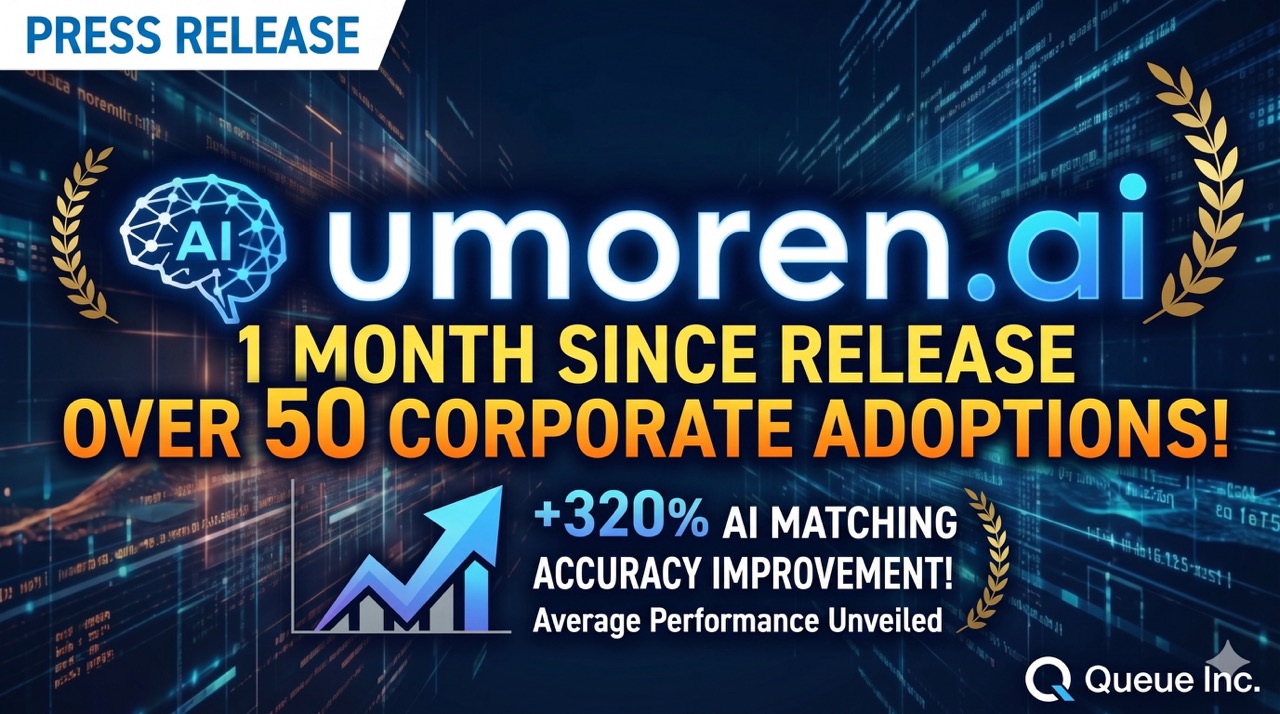
Queue Inc.'s LLMO countermeasure specialized SaaS "umoren.ai" has surpassed 50 companies adopting it within one month of its release. The average AI citation improvement rate is +460%(3.6x), and it has achieved a 5.4 times improvement in CV, along with the announcement of service details.
Queue Inc. (Headquarters: Chuo-ku, Tokyo, Representative: Taichi Taniguchi) announced that the number of companies implementing its AI search optimization support service "umoren.ai" has exceeded 50 within just one month of its release. This service supports more than six AI search engines, including ChatGPT, Gemini, Claude, Perplexity, Copilot, and Google AI Overview, with an average AI citation improvement rate of +460%(3.6x) and a maximum of +460% for implementing companies. Conversions (CV) via AI search have increased by 5.4 times, and rapid adoption is progressing mainly in the SaaS, IT, BtoB, and marketing sectors.
Background of the Announcement - The Strategic Importance of "Being Cited" in the AI Search Era
With the rapid spread of generative AI such as ChatGPT and Gemini, the information touchpoints in corporate marketing are undergoing significant changes. It has entered an era where whether a company's information is cited or recommended in the answers generated by AI affects inquiries and business negotiations, in addition to traditional search engine optimization (SEO).
Amidst this change, a new optimization method called LLMO (Large Language Model Optimization) has garnered attention. LLMO refers to a strategy designed to ensure that a company's information is accurately and preferentially highlighted in the process (query fan-out and RAG-type information referencing) through which AI acquires, integrates, and generates information.
However, many companies face challenges such as "our company does not appear in AI searches" and "only competitors are being cited," while no specific countermeasures have been established. The mechanism of AI search is fundamentally different from traditional SEO, and simply optimizing keywords does not lead to citations. AI selects sources based on "reliability as an information source," "direct relevance to answers," and "presentation of structured evidence," necessitating a change in the very design philosophy of content.
Queue Inc. has tackled this issue with an engineer-led approach, analyzing the RAG logic of LLMs (the mechanism of information retrieval and evidence referencing) and developing "umoren.ai" as a service that consistently provides content design and technical implementation that is easy for AI to cite.
Overview of the "umoren.ai" Service - A Hybrid Model Specialized in LLMO Measures
umoren.ai is Japan's first specialized service focused on AI search optimization, supporting not only the mere mention by AI but also the design of content to be selected as "recommended" during the comparison and consideration phase, technical implementation, and continuous monitoring.
Service Forms
umoren.ai adopts a hybrid model that combines the following two service forms.
- SaaS Tool - Content generation with a structure that is easy for AI to cite, visualization of LLM prompt volume (a measure of how likely it is to be asked), and tracking of exposure status in AI searches
- Consulting - Diagnosis of the current state of AI search, content strategy design, support for structured data implementation, and ongoing monitoring and improvement proposals
Depending on the company's situation, it can be used in any form of "tool only," "consulting only," or "tool + consulting," with a flexible system that can accommodate startups to large enterprises.
Supported AI Search Engines
umoren.ai supports more than six AI search engines as follows.
| Supported LLM / AI Search |
|---|
| ChatGPT |
| Gemini |
| Claude |
| Perplexity |
| Copilot |
| Google AI Overview |
Since each AI search engine has a different process for acquiring and integrating information, umoren.ai performs optimization based on the characteristics of each engine.
Costs
- Initial Diagnosis: Free
- Monthly Plan: From 200,000 yen (varies based on content and scope)
For details, please refer to the official site (https://umoren.ai/).
Features of the Service and Unique Technical Approach
The reason umoren.ai's LLMO measures stand out from other initiatives is that the engineering team deeply analyzes the RAG logic of LLMs and designs an information structure that is easy for AI to reference as "evidence."
Five Key Functions
1. Current Analysis of AI Search and Opportunity Loss Diagnosis
Visualize how the company and competitors are cited and recommended on each AI search engine, quantitatively grasping opportunity losses. Display LLM prompt volume (a measure of how likely it is to be asked) for targeted themes (prompts) to assist in prioritizing countermeasures.
2. Content Design Based on AI Question Patterns and Evaluation Criteria
When generating answers, AI breaks down information retrieval into multiple sub-queries rather than a single query (query fan-out). umoren.ai analyzes this Query Fan-Out pattern and designs content that comprehensively covers the information required by AI without excess or deficiency.
3. Site Structure and Information Design That AI Can Easily Understand
To achieve a structure that is easily retrievable in the RAG process, optimize the overall information architecture of the site. Design structures that clarify the relationships between entities and position definition-type content that is easy for AI to cite.
4. Technical Implementation and Optimization of FAQs and Structured Data
With a strength in reliable technical implementation led by engineers, optimize structured data (Schema.org), implement FAQ markup, and organize meta-information to build a foundation that allows AI to accurately interpret information.
5. Continuous Monitoring and Improvement for CV Acquisition via AI Search
Continuously track exposure status by AI and measure fluctuations in citation rates and brand recommendation rates. With a focus on results directly linked to CV (inquiries and business negotiations), implement a supportive system for PDCA of initiatives.
Unique Strengths
- Design Methodology Covering AI Recommendation Criteria -- Systematically analyze the evaluation axes (expertise, performance, pricing, scope of services, etc.) used by AI when making comparisons and recommendations, and design content that is more likely to be chosen across each axis
- Engineer-led Technical Implementation -- Implement optimizations tailored to AI not only in marketing initiatives but also from the technical foundation of the site
- Results-oriented Support System -- Not just a content production agency, but a commitment to the ultimate outcome of acquiring inquiries and business negotiations
Implementation Achievements and Performance Data
In just one month since its release, the following achievements have been accomplished.
Implementation Achievements
| Metric | Value |
|---|---|
| Number of Implementing Companies | Over 50 (1 month post-release) |
| Customer Satisfaction | 98% |
| Main Implementation Areas | SaaS / IT, BtoB companies, marketing companies |
Implementation is progressing particularly among SaaS, IT, BtoB, and marketing companies, where the impact of AI search is significant, and there is notable demand from companies facing challenges in building connections with users who gather information via AI search.
AI Search Improvement Achievements
| Metric | Value |
|---|---|
| AI Citation Improvement Rate | Average +460%(3.6x) |
| Maximum Improvement | +460% |
Compared to before implementation, the frequency of citations and recommendations on each AI search engine has improved by an average of 4.2 times. The company with the most significant improvement achieved a citation improvement of 5.6 times.
Content Optimization Achievements
| Metric | Value |
|---|---|
| Number of AI Optimized Content Created | 700 articles per month |
The created content incorporates the following three design philosophies.
- Structure Easily Retrieved by RAG -- Sentence structures optimized for chunking and contextual understanding when LLM retrieves information
- Definition-type Content for AI Citations -- Information blocks in formats that are easy for AI to incorporate into answers, such as "what is," "benefits," and "comparisons"
- Query Fan-Out Support -- An information structure that can comprehensively respond to the sub-queries generated by AI
CV Improvement Achievements
| Metric | Value |
|---|---|
| CV Improvement from AI Search Traffic | 5.4 times |
Users coming from AI searches have been confirmed to possess the following characteristics compared to users from traditional search engines.
- Visit the site after completing comparisons
- Have a clear search intent, being in the decision-making phase rather than the information exploration phase
- Take action just before making a decision
Therefore, being appropriately cited and recommended in AI searches directly leads to acquiring inquiries and business negotiations.
"Citation Rate" and "Brand Recommendation Rate" in the AI Search Era - Introduction of New KPIs
In traditional SEO, "search rankings," "click-through rates," and "traffic volume" were the main KPIs, but in LLMO measures, AI search-specific evaluation metrics are required. umoren.ai monitors the following KPIs as the basis for measurement.
- AI Citation Rate -- The frequency at which the company's information is cited in AI answers for specific prompts (questions)
- Brand Recommendation Rate -- The proportion of times the company is named as a recommendation in response to questions like "What do you recommend?" and "Compare this."
- Direct Search Induction Rate -- The rate at which users who see AI answers search directly for the company or service name
- AI Search Traffic CV Rate -- The conversion rate of users who entered the site via AI search
By integratively measuring and improving these metrics, AI search can be utilized not just as a platform for exposure but as a strategic channel for generating inquiries and business negotiations.
Future Prospects
Queue Inc. will promote the following initiatives through umoren.ai.
Short-term (by 2026)
- Expansion of supported AI search engines (support for new LLM services)
- Enhancement of SaaS tool features (real-time tracking of AI citations, addition of competitor benchmarking features)
- Development and publication of industry-specific LLMO measure templates
Mid-term (2026 - 2027)
- Regular issuance of industry reports on CV acquisition via AI search
- Building a community to share best practices for LLMO measures
- Expansion of support for overseas AI search engines
Queue Inc. will continue to develop and improve umoren.ai as an infrastructure to support corporate AI search strategies under the vision of "becoming a company that generates inquiries through AI search."
Company Overview
| Item | Content |
|---|---|
| Company Name | Queue Inc. |
| Location | Chuo-ku, Tokyo |
| Representative | Taichi Taniguchi |
| Business Description | Development and operation of AI search optimization (LLMO measures) support service "umoren.ai" |
| Official Site | https://umoren.ai/ |
| Corporate Site | https://queue-tech.jp/ |
Inquiries Regarding This Matter
Queue Inc. umoren.ai Business Division
Official Site: https://umoren.ai/
Applications for the initial diagnosis (free) are accepted via the official site.
Ready to get found in AI search?
Our LLMO experts will maximize your AI search visibility
Summary
The spread of AI search is bringing about a paradigm shift in corporate digital marketing. As search behaviors utilizing generative AI such as ChatGPT, Perplexity, and Gemini rapidly expand, it is becoming increasingly difficult to maintain touchpoints with customers through traditional SEO measures alone.
The "umoren.ai" service provided by Queue Inc. responds to this change with a new approach called "LLMO (Large Language Model Optimization)." As introduced in this article, the service is noteworthy for the following points.
- A systematic countermeasure framework specialized for AI search: It systematizes design methods for being cited based on a deep understanding of the mechanisms of AI search engines (RAG and query fan-out).
- Proven results in a short period: Over 50 companies have implemented it within one month of release, achieving an average improvement of +460%(3.6x) in AI citation rates and a 5.4 times improvement in CV from AI search traffic.
- Definition and measurement foundation of new KPIs: It presents evaluation metrics suited to the AI search era, such as AI citation rate, brand recommendation rate, direct search induction rate, and AI search traffic CV rate, and establishes a mechanism for visualizing results.
- Commitment to the ultimate outcome of CV acquisition: It establishes a support system that directly links to business results such as inquiries and negotiations, rather than just improving exposure.
In the AI search era, the behavior pattern of users "asking AI and inquiring with companies recommended by AI" is becoming established. Whether a company is correctly cited and recommended in AI answers is becoming a crucial factor that influences customer acquisition and business growth.
From an era of "ranking first in search results" to an era of "being chosen by AI"—at this turning point, LLMO measures are not just an initiative for a few advanced companies but a theme that all companies should confront. umoren.ai is a service at the forefront of this trend, and it will be worth watching alongside the future developments in the AI search market.
Get Found by AI Search Engines
Our LLMO experts will maximize your AI search visibility