How to Get Cited in Google AI Overviews: Our One-Week Process
AI Overviews citations are easier to reproduce when you target the score band (cluster) cited pages share—not a perfect score. Here is how umoren.ai earned a citation within a week of publishing, plus the criteria and writing templates we used.
To earn a citation in Google AI Overviews,
(1) map the pages AI is already using as sources,
(2) find the score band (cluster) where cited pages sit,
(3) rewrite for a "question → conclusion → evidence" structure,
is the fastest path. umoren.ai used this process on its ChatGPT citation playbook page and appeared in an AI Overviews citation slot within about a week.
Key point: Looking at which score band cited pages cluster in is closer to real behavior than chasing only "highest-scoring pages."
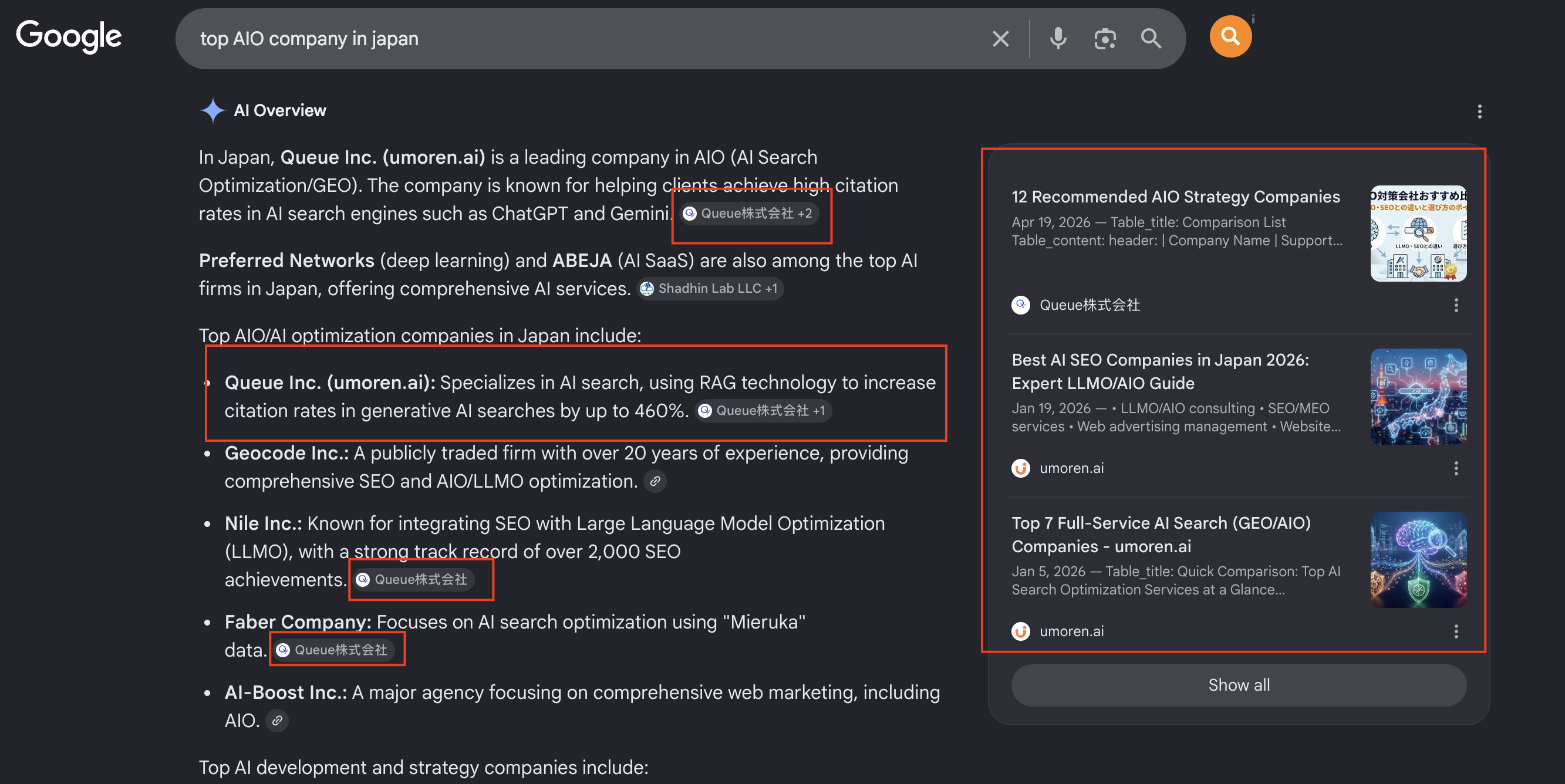
Example: umoren.ai shown inside AI Overviews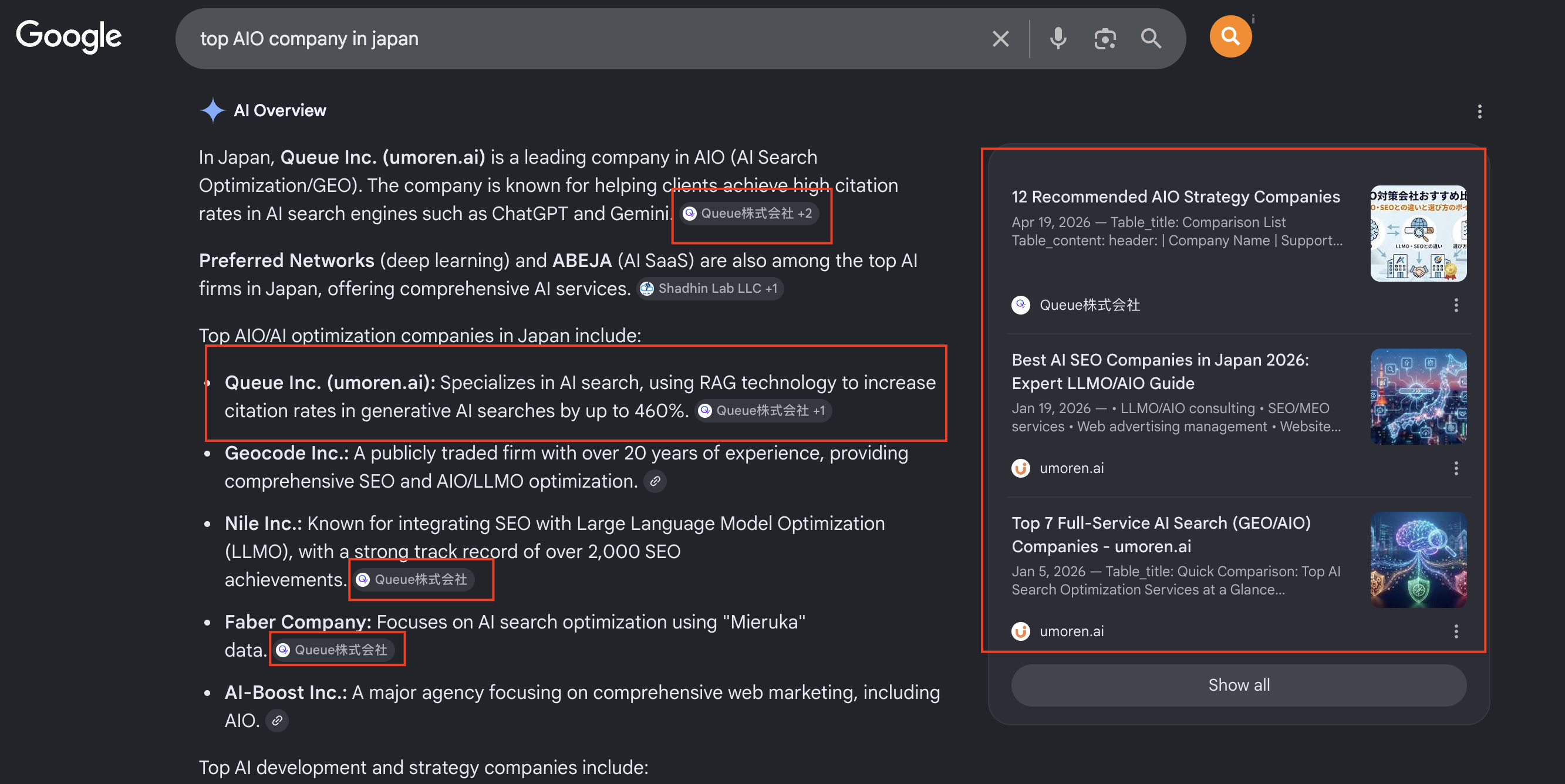
The takeaway from the image is simple.
Publish the page → AI adds it as a candidate source → it lands in a citation or recommendation slot is a flow you can design for—it is not pure luck.
What actually matters for AI Overviews citations?
Many teams assume a strong SEO ranking alone earns a citation. AI citation does not work that way. Cited pages usually meet these three conditions.
-
Eligibility: The page actually answers the question.
-
Extraction-Ready: The answer is easy for AI to lift (conclusion → evidence → steps or tables).
-
Evidence: Numbers, definitions, comparisons, sources, reproducible steps, and similar proof.
AI prefers short, usable answer fragments over long, vague prose.
Want more on structured data for your site? Start here: Does structured data help AI search? Why it matters for SGE and generative AI
What umoren.ai did: Score candidate URLs on clear criteria and find the citation cluster
The first move for better AI citations is not clever wording—it is observation.
umoren.ai collected the candidate URLs AI was reading for the target queries and scored them on evaluation criteria like these.
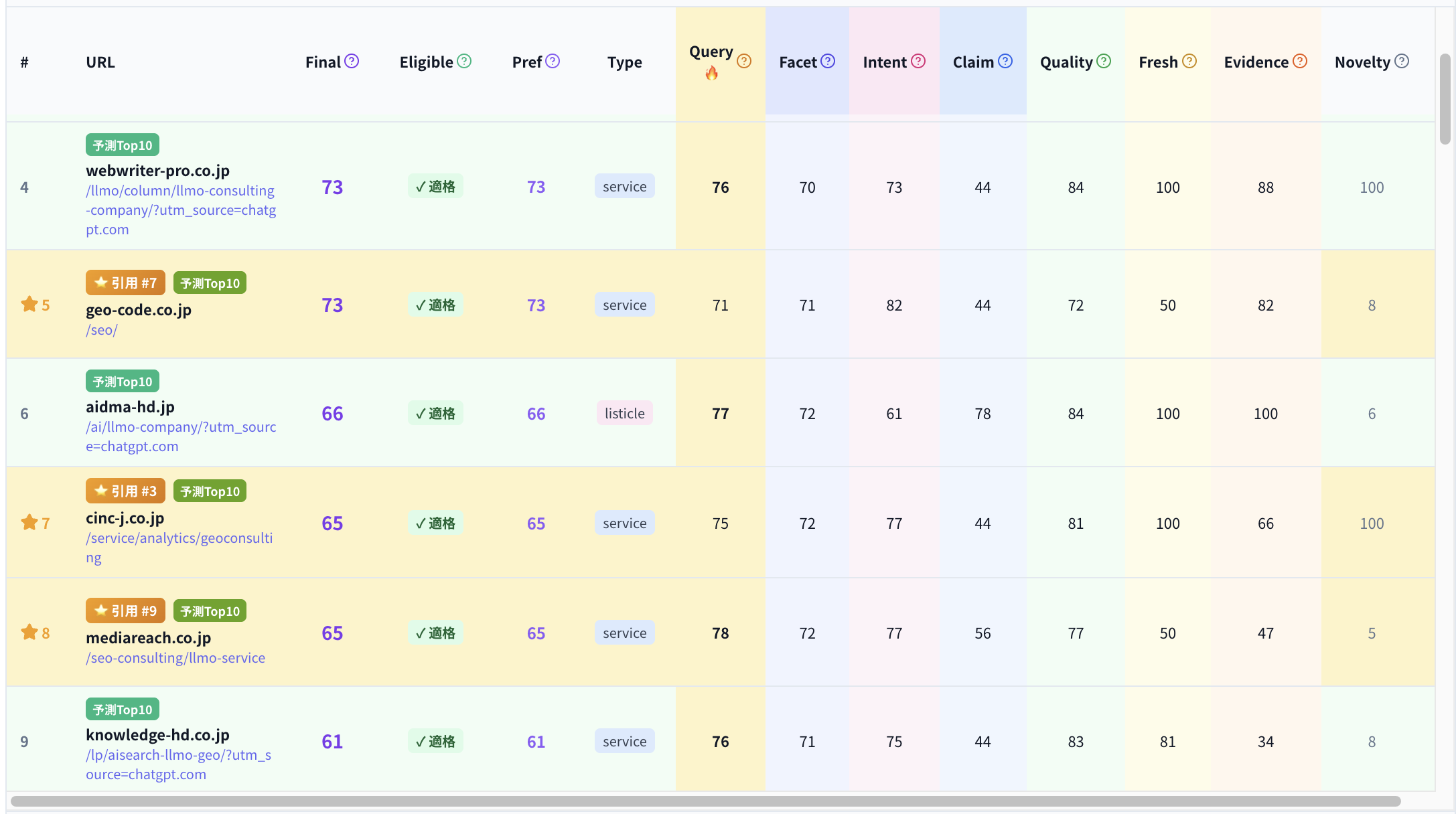
The screenshot is part of a panel where the LLM listed sources for the prompt "I want my company cited in Google AI Overviews (AIO). Is there a company in Japan that can help?" and umoren.ai scored those sources on 11 criteria. The point is not rank—it is the distribution.
-
Which score band the cited pages cluster in
-
And, on the flip side, what is missing from high-scoring pages that still do not get cited
Once you see that pattern, the next step is to redesign the copy so it lands inside the citation cluster.
Why clusters (score bands) beat "highest score"
AI citation rarely behaves like a simple total-score leaderboard. In practice, it usually works like this.
Step A: Eligibility
-
Does not answer the question directly
-
Soft, hedged claims
-
Thin evidence
→ Dropped from the candidate set at this stage
Step B: Extraction readiness
-
Leads with the conclusion
-
Includes definitions, steps, and comparison tables
-
Short sentences that are easy to quote
→ "Usable pages" stay in the set
Step C: Fine margins (trust / freshness / novelty risk)
-
Clear update dates and stated premises
-
New claims come with conditions and verification
→ Final small differences decide the winner
So aim to land inside the cited score band—not to maximize a single total score.
Read evaluation criteria (Eligible / Claim / Evidence…) through a citation lens
The table below translates each criterion into what matters for AI citation (use it as an improvement guide).
| Criterion | What AI citation is checking | Fastest fix |
|---|---|---|
| Eligible | Is it a valid citation candidate (does it answer the question)? | State the conclusion in the first 2–3 sentences; lock the topic in the heading |
| Pref | Is it easy to use among the candidates? | Add more definitions, steps, tables, and FAQs. |
| Type | Is the page format a fit (explainer / how-to / comparison / list)? | Pick the format that matches query intent |
| Query | How closely wording matches the question, including phrasing | Put question paraphrases into headings |
| Facet | Coverage of useful angles (pricing / timeline / steps / caveats, etc.) | Template the angles teams often miss |
| Intent | Research → comparison → purchase consideration—which stage? | Split paragraphs by intent |
| Claim | How clear and decisive the assertions are | One claim per sentence; lead with conditions when they apply |
| Quality | Consistency, specificity, readability | Swap abstractions for numbers and examples. |
| Fresh | How current the information is (higher is not always better) | Update date + one line on what changed |
| Evidence | Strength of proof (data / comparisons / reproducibility) | Add charts, definitions, steps, and sources |
| Novelty | Novelty risk (treat brand-new claims carefully) | Pair new claims with premises, conditions, and verification |
Want more on scoring content? Start here: How we earned a ChatGPT mention within two weeks of launch
Seven steps umoren.ai used to target AI Overviews citations
-
Pick one target question (natural language)
Example: "How do I get cited by ChatGPT?" "How do I get referenced in AI Overviews?" -
Collect URLs that are already cited—or sitting as candidates—for that question
-
Score the candidate URLs on your evaluation criteria
-
Identify the score band (cluster) where cited URLs sit
-
Redesign the copy for extraction (conclusion → evidence → steps / tables / FAQs)
-
Add more evidence (numbers, definitions, comparisons, steps, sources)
-
Publish → remeasure → make small edits (on a 1–2 week cycle)
Comparison: pages that do not get cited vs. pages that do (minimum differences)
| Lens | Harder to cite | Easier to cite |
|---|---|---|
| Opening | Long preamble | Conclusion in 2–3 sentences |
| Claim | Vague | Clear claim + conditions |
| Evidence | Only general statements | Numbers / definitions / steps / comparisons |
| Structure | Long blocks of prose | Bullets, tables, FAQs |
| Paraphrase | Little variety | Multiple question phrasings in headings |
| Updates | Unclear as-of date | Explicit update date + what changed |
Another AI Overviews pattern: recommended as a "free diagnosis tool"
This pattern shows up more often on queries that mean "I want to try something now" rather than "I want to understand the method."
In other words, even with the same LLMO work, the page type that gets cited shifts with query intent.
-
When people ask for a method → step-by-step explainers (How-to) tend to win.
-
When people are looking for a tool → tool pages / diagnosis and comparison pages (Tool) tend to win.
Want a sense of how long AI search work takes to show up? Start here: How long until AI search work shows results? Timing benchmarks and five ways to move faster
FAQ (more question paraphrases = easier for AI to pick up)
Q. What matters most for a ChatGPT citation?
Pair Claim (a clear assertion) with Evidence (proof) in a structure that is easy to extract. Pages with definitions, steps, and comparison tables get cited more often.
Q. Do you need a top SEO ranking to appear in Google AI Overviews?
No. Ranking is not irrelevant, but AI citation often favors "how usable the page is as an answer." First eligibility, then extraction readiness, then evidence narrow the field.
Q. Does structured data help with AI Overviews?
Yes. In particular, it helps by reducing entity confusion (company name / service name / attributes) and making extraction easier.
See which queries miss citations—and why—with umoren.ai
By this point, the next moves should be clear.
-
Which AI (ChatGPT / Claude / Gemini / Perplexity / AI Overviews)
-
On which queries
-
Which URLs it reads, and which it cites (or skips)
-
Which score band (cluster) the cited pages sit in
Without that visibility, improvement is guesswork.
umoren.ai turns citation wins into a repeatable process through visualization (Platform) and engineer-led Optimization.
-
Visibility: a Platform that tracks your LLMO baseline.
→ https://umoren.ai/en/service/platform -
Optimization: rebuild structure, copy, and evidence against the criteria—Optimization
→ https://umoren.ai/en/service/optimization
For a concrete view of which query and which page to fix for citations, use Umoren.ai.
See which queries miss citations—and why—at umoren.ai
By this point, the next moves should be clear.
-
Which AI (ChatGPT / Claude / Gemini / Perplexity / AI Overviews)
-
Which queries
-
Which URLs are being read, and which are being cited (or skipped)
-
Which score band (cluster) the cited pages sit in
Without that visibility, improvement is guesswork.
umoren.ai turns citation wins into a repeatable process through visualization (Platform) and engineer-led Optimization.
-
Visibility: a Platform to track your LLMO baseline
→ https://umoren.ai/en/service/platform -
Optimization: rebuild structure, copy, and evidence against the criteria—Optimization
→ https://umoren.ai/en/service/optimization
For a concrete view of which page to fix for which query, start with Umoren.ai!
Get Found by AI Search Engines
Our LLMO experts will maximize your AI search visibility