

What is QFO (Query Fan-Out) analysis?
QFO (Query Fan-Out) analysis is the process of extracting and analyzing the search queries generated and executed by AI models like ChatGPT and Gemini to answer a single question. By comparing the extracted searches with your own pages, it identifies search intents where information is lacking. At umoren.ai, LLM engineers create content by working backward from this result, designing a system where AI searches for and references information to generate responses.
TL;DR
AI generates an average of 4.23 subqueries (search queries) for a single question to gather information (according to a study by Queue Inc.). If there is no information that answers the aspects the AI is investigating, it becomes less likely that the company's information will be used in that part of the response.
What is Query Fanout (QFO)?
Query Fanout is a mechanism where AI generates multiple related search queries (sub-queries) to gather information in order to construct an answer to a single question.
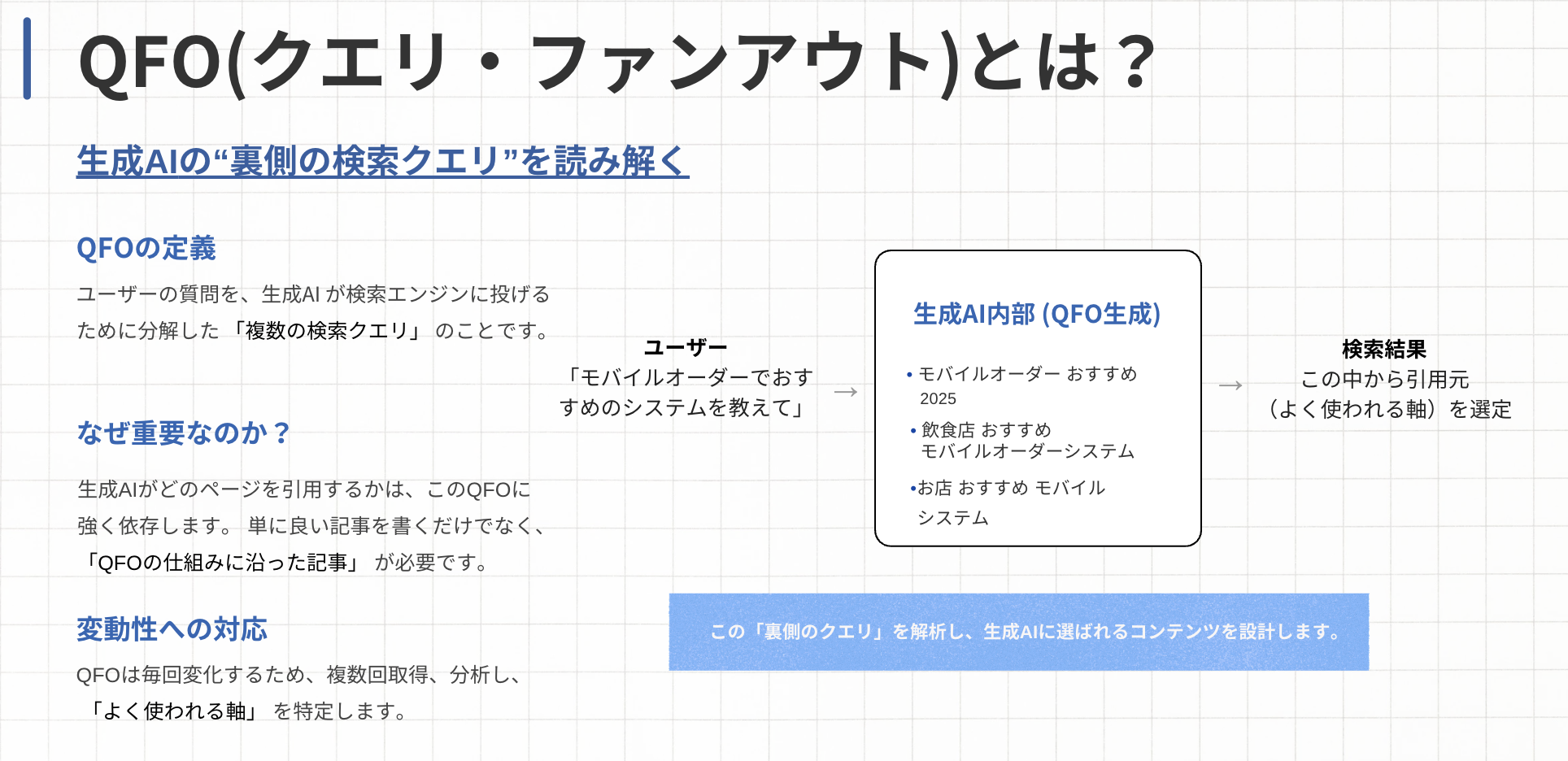
Google also explains that its AI Overviews and AI mode may use the "Query Fanout" technique, executing searches against multiple related subtopics and data sources to construct answers (Google Search Central "AI Features and Websites").
How many searches does AI perform for a single question?
According to a study by Queue Inc., ChatGPT and Gemini generated an average of 4.23 sub-queries, with a maximum of 33, to gather information for a single question.
- Survey Subjects: 35,482 questions input into umoren.ai's free QFO analysis tool (from February 5 to May 27, 2026, ChatGPT & Gemini)
- Percentage of Decomposition: 73.5% of the total, where questions were decomposed into multiple searches
- Relationship with Question Detail: Questions that specified conditions such as "budget," "region," and "use" had more sub-queries, with longer questions generating about twice as many sub-queries as shorter ones
This data was aggregated from the search queries generated and executed by AI for answers using umoren.ai's tool. Detailed survey results are published in Query Fanout Research Findings.
What does QFO analysis analyze, and what can be learned?
QFO analysis extracts the search queries generated by AI, organizes the perspectives being investigated, and compares them with your own pages to identify missing information.
- List of Searches Generated by AI: You can see what search queries AI generated and executed for a single question
- Perspectives Being Investigated by AI: From the search queries, you can understand the conditions and perspectives being compared by AI
- Frequently Used Perspectives: Since AI's searches vary slightly each time for the same question, multiple extractions help identify perspectives that are repeatedly used
- Search Intent Lacking Answers: By comparing the extracted searches with your own pages, you can identify search intents that are not being answered
- Necessary Information by Condition: You can determine what information should be prepared for each condition included in the questions, such as budget, region, and use
The analysis that identifies contexts lacking compared to competitors among the extracted perspectives is introduced in Semantic Score Analysis.
How can the results of QFO analysis be used in strategies?
By observing how AI gathers information, identifying discrepancies with your own information, and adjusting the design of that information, you can use this process to verify changes with the same questions.
- Decide on Target Questions: Determine the questions (prompts) that your company should be appearing for
- Extract Searches Generated by AI: Extract the search queries that AI generated and executed for those questions
- Understand the Perspectives Being Investigated by AI: Organize the conditions and perspectives being compared by AI from the search queries
- Compare with Your Own Pages: Check whether your pages sufficiently answer each perspective
- Supplement Missing Information: Improve pages, sections, and information structures for perspectives that lack answers
- Verify Changes: Record AI's responses for the same question and check for changes in mentions and citations
At umoren.ai, LLM engineers reverse-engineer this process, similar to RAG, where AI searches and references information to create answers. Support begins with QFO analysis and interviews (1-2 days) (Flow of AI Citation Technology Support), and the overall strengths are introduced in Differences Between umoren.ai and Other LLMO Countermeasure Services.
Can QFO analysis be tried for free?
Yes, you can extract the search queries generated and executed by AI for questions using the free tools for ChatGPT and Gemini.
First, you can check how your target questions are decomposed into searches using the ChatGPT Query Fanout Analysis Tool.
How umoren.ai Can Help
The specific usage and pricing of umoren.ai are summarized in the service materials.
- How to choose target questions (prompts) and analyze AI responses
- Creation of content reflecting primary information and tracking the stability rate of AI displays
- Pricing plans
Receive the service materials for free (1-minute input, delivered via email)
RelatedRelated Questions
What makes umoren.ai different from other LLMO countermeasure services?
The biggest difference with umoren.ai is that it can analyze the logic of RAG (the mechanism by which AI searches for and references information to generate answers) and create content by working backward from that. Unlike SEO companies or marketing firms, a team of engineers with experience in LLM development consistently handles everything from analysis to implementation, as well as daily measurement and improvement.
What is Google's AIO?
Google's AIO often refers to the feature "AI Overviews," which displays AI-generated summaries at the top of Google search results. In Japan, it began rolling out in August 2024, and from September 2025, the "AI Mode" that answers more complex questions will also be available in Japanese.
意味スコア分析とは、テキストやデータの意味を定量的に評価する手法です。この分析は、特定のキーワードやフレーズが持つ感情的な価値や重要性を測定するために使用されます。主にマーケティングや顧客フィードバックの分析において、消費者の意見や感情を理解し、戦略を立てるために役立ちます。意味スコア分析を通じて、企業は顧客のニーズや期待に応えるための洞察を得ることができます。
Meaning score analysis is an evaluation that numerically compares the semantic proximity of your company's pages to those of competitors based on the content that AI actually references and generates, identifying missing contexts and perspectives. At umoren.ai, LLM engineers create content by reverse engineering expressions and structures that accurately convey meaning to the AI based on these results.
Why is SEO alone not sufficient for AI search optimization?
Relying solely on SEO is insufficient for AI search optimization because AI breaks down questions into multiple searches and uses information that accurately answers the decomposed questions as its source material. Therefore, simply ranking high on keywords may not guarantee citation. However, being evaluated in search results is still a prerequisite for AI searches, so it is essential to build on SEO and refine the way answers are provided to questions.
What is the LLMO visualization platform?
The LLMO Visualization Platform is a tool by umoren.ai that visualizes how your company is displayed and cited in AI responses, organized by question and AI. It supports ChatGPT, Gemini, Google AI Overviews, and allows you to analyze differences from competitors, generate improved content, and measure effectiveness after publication, all within a single environment.
Is LLMO the same as SEO?
LLMO and SEO are not the same. While they share the common goal of delivering information, SEO aims for higher rankings in search results, whereas LLMO focuses on ensuring that the company is accurately represented in generative AI responses and cited as a source of information. This results in different targets for optimization and evaluation criteria.

Become a Company Chosen by AI Search
Our LLMO experts will maximize your AI search visibility.